
Direct Mail Volume Surges: What’s Going On? and What To Do Next...
“Brands will send an average of 67.3 million pieces of mail this year — up from 34.9 million in...
By: Matt Witter Sep 24, 2026, 1:12:00 PM
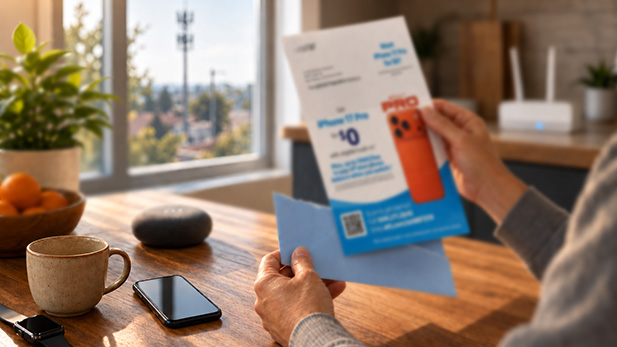
Wireless is entering its third major wave of growth. Unlike the last two, this one isn’t likely to be driven by new devices or network claims. It’s driven by proximity to the customer relationship.
As new brands and broadband providers compete with traditional wireless carriers, the battleground is shifting from network infrastructure to simplicity, bundling, and brand trust. Within that shift, one channel has consistently proven its value across every era of wireless: direct mail.
In the first wireless wave, feature phones drove wireless penetration from near zero to over 100%, as households adopted multiple lines. During this phase, direct mail played a critical role in educating consumers, promoting device offers (including countless Nokias, Samsung sliders, and Motorola RAZRs), and driving mass-market adoption.
The second wave was defined by smartphones (iPhone, not Blackberry) and data. Carriers shifted from acquisition to retention and expansion, using family plans, add-a-line offers, and tiered data pricing to grow revenue. Direct mail evolved alongside this shift, becoming a precise tool for upselling, educating customers on coverage and plans, and driving competitive switching.
Across both waves, one pattern held true: Direct mail remained foundational to acquiring, educating, growing ARPU, and reducing the churn of wireless customers.
Today, wireless has reached saturation. Nearly everyone who wants a smartphone already has one. Future growth will come from how connectivity is cleverly packaged, priced, and embedded into broader ecosystems.
This third wave is defined by three major shifts:
Broadband providers, especially cable MSOs and fiber operators, are stepping into the customer relationship, using wireless as part of a broader bundle, often pricing aggressively to win share. In effect, carriers are becoming infrastructure providers, while brands compete to own the customer relationship.
Behind the scenes, carriers still own the networks, but increasingly they function as wholesale providers, while different brands control the customer.
Wireless is no longer a standalone product. It’s becoming embedded within:
The barrier to launching wireless brands has dropped dramatically. What hasn’t changed is the challenge of establishing trust and acquiring and retaining customers at scale.
Newer entrants and emerging infrastructure players like Starlink show that network innovation still matters, particularly in underserved markets. But even the most advanced network must solve for distribution: acquiring customers efficiently, building trust, and scaling reach. Over time, that means leveraging proven channels to connect with and convert consumers at scale.
At first glance, it might seem like a digital-first market would sideline physical channels. The opposite is happening.
As wireless increasingly bundles with broadband and other services, decision-making shifts to the household level, where direct mail excels.
Customer acquisition through digital channels has become more expensive and less predictable. Signal loss and targeting limitations have made it harder to consistently reach high-value households.
For emerging MVNOs and new brands, the biggest challenge isn’t necessarily awareness but credibility. A well-crafted mail piece creates a level of tangibility and legitimacy that digital ads often cannot.
Changing wireless providers is a high-consideration decision. Direct mail provides the space and clarity needed to:
Modern direct mail execution is not saturating the addressable market in wireless coverage areas. Instead by leveraging propensity modeling and advanced segmentation, savvy wireless marketers can identify customers most likely to respond based on factors like switching behavior, multi-line potential, household dynamics, broadband bundling likelihood, and competitive exposure.
This enables programs that are:
For companies looking to compete in this new environment, the priorities are clear:
What makes this moment unique is that success requires both:
Direct mail helped power the first two waves of wireless. In this third wave, where distribution determines winners, mail can be a critical advantage for brands looking to build, scale, and take share.
For more information on direct mail channel building, checkout these resources:
See how RPM helps prepare wireless carriers for the Third Wave with data-driven campaigns that drive customer acquisition and brand loyalty.
“Brands will send an average of 67.3 million pieces of mail this year — up from 34.9 million in...
While it’s tempting to compare digital marketing and direct mail to find out which one is “better,”...
Agency mergers are stacking up—Omnicom and IPG are chasing a $25-billion network, while BBDO’s...